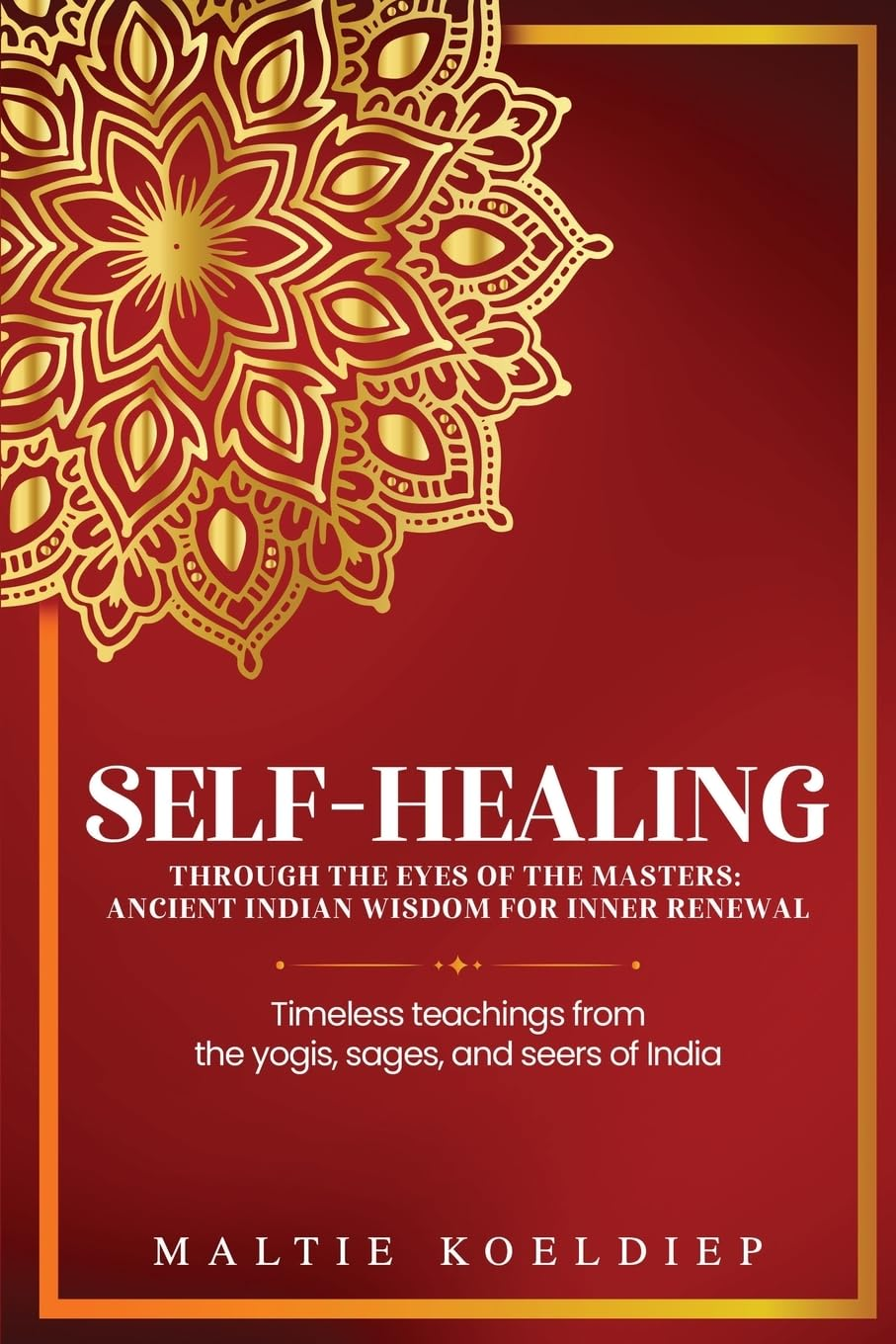
What defines you? Is it your thoughts, your emotions, your physical presence, or something deeper that cannot be seen or measured? In Self-Healing Through the Eyes of the Masters: Ancient Indian Wisdom for Inner Renewal by Maltie Koeldiep, this question becomes central to understanding true inner peace. The book introduces Advaita Vedanta in a way that feels clear and approachable, guiding you to reconsider what you have always assumed about yourself.
Advaita Vedanta is built on a simple yet profound idea. You are not divided into separate parts. There is no separation between you and the deeper reality of existence. What you often identify as “yourself” such as your body, your thoughts, your emotions is only a surface layer. Beneath it lies something constant and unchanging.
Your body changes over time. Your thoughts shift from one moment to the next. Your emotions rise and fall depending on circumstances. If all of these are constantly moving, can they truly define who you are? This teaching suggests that they do not. Instead, there is an awareness behind all of them. It is the quiet presence that notices your thoughts, experiences your emotions, and observes your surroundings. This awareness does not change in the same way your mind and body do. It remains steady, even when everything else feels unstable.
Understanding this distinction can transform how you experience life. When you identify only with your thoughts, every negative idea feels overwhelming. When you identify only with your body, every discomfort feels personal and limiting. But when you begin to recognize the awareness behind these experiences, you create space.
That space allows you to respond rather than react. It helps you see your thoughts as passing events rather than fixed truths. It reduces the intensity of emotional highs and lows. You are still experiencing life, but you are no longer fully defined by every fluctuation.
This shift is not about rejecting the body or the mind. It is about seeing them clearly. They are tools through which you experience the world, not the core of your identity. When this understanding deepens, a sense of calm begins to develop. There is less need to control everything, less attachment to outcomes, and more acceptance of what is.
Maltie Koeldiep presents these ideas in a grounded and accessible way. The focus is not on abstract philosophy, but on how this understanding can support healing. When you stop identifying with every thought and emotion, stress begins to lose its grip. You become less reactive, more centered, and more aware of your inner state.
This perspective does not require you to withdraw from life. It encourages you to engage with it more clearly. You still think, feel, and act, but with a deeper sense of stability. If you have ever questioned whether you are more than your thoughts and your body, this book offers a thoughtful path to explore that possibility.
Read this book, available on Amazon: https://www.amazon.com/dp/1971228133/.